Diberdayakan oleh Blogger.

Rabu, 04 Mei 2016

Star Wars


The epic space-opera continues, with Han Solo, Princess Leia and a new team of fighters on a quest to find the great Jedi master, Luke Skywalker.

EDITOR'S NOTE: While every effort has been made to avoid spoilers, those seeking an untainted viewing experience are advised to avoid reviews, this one included, until after they've seen the movie.)

Trailer:


When George Lucas sold Star Wars to Disney in 2012 for US$4 billion, his generational space saga was a spent force both creatively and economically. The Force Awakens is Disney’s effort to reverse that. While the story continues on from the events of Return of the Jedi, it’s best to look at it as a reboot of the franchise; much of the plot, right down to individual scenes, is lifted from the original 1977 Star Wars, while the central characters are largely mix-and-match versions of the first film’s core cast. 

Finn (John Boyega), a Stormtrooper who deserts at the start of the film once he realises what being a Stormtrooper entails, is our average guy; the one with a larger destiny to fulfil is Rey (stand-out Daisy Ridley), a scavenger on the desert planet Jakku who finds droid BB-8 (the basketball-looking one that’s going to make Disney a fortune in toy sales) and decides to help the robot complete his vital mission. Cocky pilot Poe (Oscar Issacs) is the Han Solo analogue but he doesn’t get much to do because before long the real Han Solo (Harrison Ford) turns up and aside from a few extra years he hasn’t changed a bit. Meanwhile, the sinister First Order (basically the Empire 2.0) is after the data BB-8 is carrying, and in another riff on the first film where we had Darth Vader and Peter Cushing’s Grand Moff Tarkin, we again get two bad guys: mask-wearing, lightsabre-wielding, tantrum throwing Force-user Kylo Ren, and enjoyably slimy space-Nazi General Hux (Domhnall Gleeson), both following the orders of the sinister Supreme Leader (Andy Serkis).

"If you have the slightest fondness for Star Wars, this is a lot of fun."


If you have the slightest fondness for Star Wars, this is a lot of fun: everything you could want is here, from dogfights between TIE Fighters and X-Wings to slimy alien monsters to trash compactor jokes to occasionally clunky dialogue to – especially early on during the Jakku scenes – a real sense of faded grandeur and deep history. Well, almost everything: this film’s big flaw is that in making sure it provides everything we want from Star Wars, it leaves out the surprise that was such a big part of the first film’s appeal. Again, there’s hardly a moment here that doesn’t come from an earlier Star Wars film: there’s a cantina full of dubious space villains (and a band!), an enemy base that contains a seemingly bottomless pit, a weapon that puts entire planets at risk and a scene where X-Wing fighters fly down a trench to shoot at the one tiny spot that can save the day. But in the first film all of that came as surprise after surprise; there’s no moment here with the shock of “that’s not a moon”.

The fun of The Force Awakens comes from visiting an old friend and finding that little has changed; the excitement is that great performances from all four new leads means it’s a strong foundation for whatever comes next.
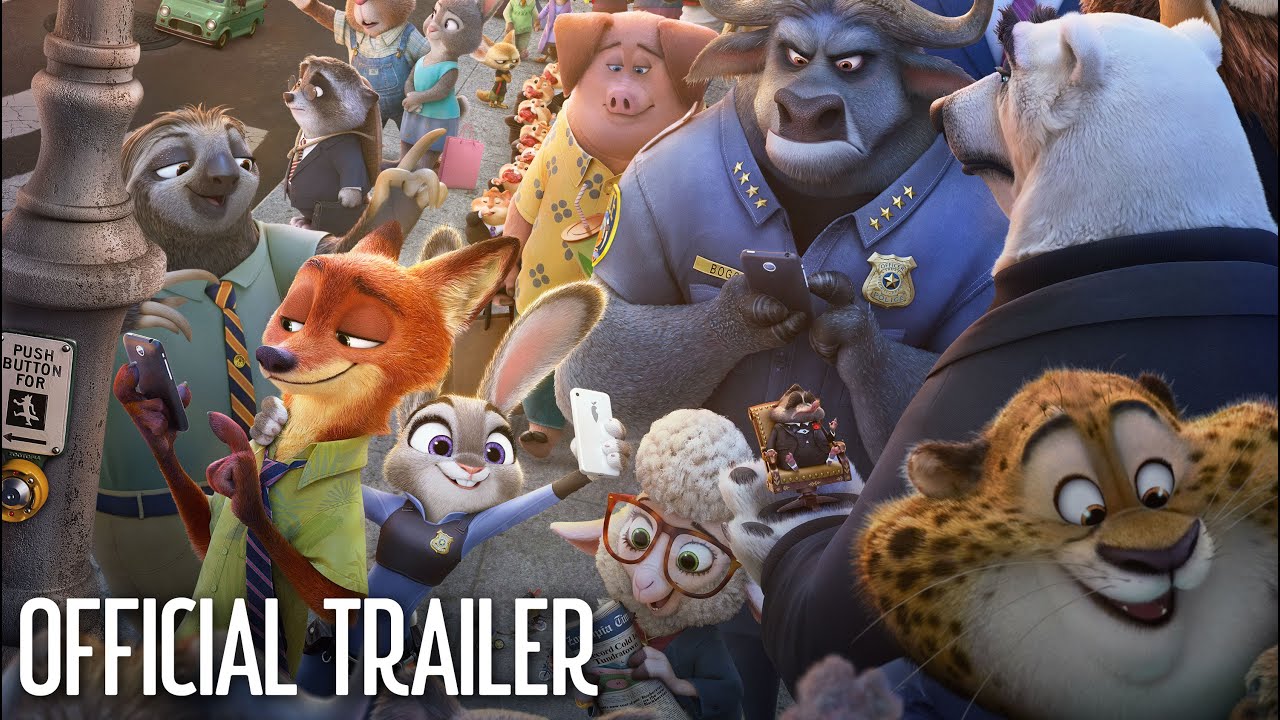
Zootopia


In the animal city of Zootopia, a fast-talking fox who's trying to make it big goes on the run when he's framed for a crime he didn't commit. Zootopia's top cop, a self-righteous rabbit, is hot on his tail, but when both become targets of a conspiracy, they're forced to team up and discover even natural enemies can become best friends.

As you watch Disney’s Zootopia, with its blandly dazzling 3-D computer animation, its plucky female protagonist and sleazy but destined-to-be-reformed male sidekick, its nonstop wisecracks and mildly progressive message of tolerance, you will be seeing the new exemplar of a corporate family blockbuster. It hits every one of its marks. My own grumpy cynicism – in full effect for the first frenetic half hour – melted away, partly by the charm of the voices and partly because the film had transformed into a clever, gumshoe mystery of the sort that studios once made all the time but are now seen as too modest. That’s right: what saves this big-budget cartoon behemoth is its modest, old-fashioned storytelling.

Trailer:


The neat idea for Zootopia’s universe – that in its futuristic metropolis (which looks suspiciously like Disney World), there are no longer predators and prey but animals of all species that co-exist more or less in harmony – seems at first beside the point in a genre where most animals get along, and speak to one another in English besides. But the screenplay by Jared Bush and Phil Johnston (from a story by those two guys, plus at least five other people with “additional story material” credit), quickly establishes that there are numerous class distinctions in the city of Zootopia.

The heroine, a plucky (I already used that adjective, but it’s unavoidable) bunny by the name of Judy Hopps (voiced by Ginnifer Goodwin), graduates from the police academy and becomes the first of her diminutive species to serve alongside rams, elephants, lions, rhinos, etc. Assigned to a humiliating parking detail, she falls gratefully on a dead-end missing person – or, rather, missing otter – case, which her boss (a booming British ram voiced by Idris Elba) gives her 48 hours to solve or else resign from the force.

To help her, she blackmails a savvy fox named Nick Wilde that she caught committing all kinds of crimes and misdemeanors. (Foxes are universally distrusted in Zootopia.) Nick is voiced with winning buoyancy by Jason Bateman, and Goodwin is beat-perfect, too: They understand that in a screwball whodunit, the tempo is paramount. You whiz with them around Zootopia (which has several climates, among them a frozen tundra) as they pore over surveillance tapes, search dark garages, and intimidate weaselly henchmen (among them a weasel called Duke Weaselton, voiced by Alan Tudyk), and think, “Gee, this is pleasant.”

Source

Sherpa


In 2013, the world's media reported on a shocking mountain-high brawl as European climbers fled a mob of angry Sherpas. Director Jennifer Peedom and her team set out to uncover the cause of this altercation, intending to film the 2014 climbing season from the Sherpa's point-of-view. Instead, they captured Everest's greatest tragedy, when a huge block of ice crashed down onto the climbing route...

Trailer :


Documentary director Jen Peedom chronicles an industrial dispute like no other in her thoughtful account of high risk at high altitude, Sherpa.

Sherpa began life as an observational doc about the indigenous guides who are the literal backbone of the Himalayan economy. Peedom and her crew, including high-altitude cinematographer Renan Ozturk, had plans to shoot a season’s worth of footage to give a sense of ‘what it’s like’ to walk in a Sherpa’s boots over the course of a climbing season. Peedom’s plan was to highlight the unfair expectations placed upon modern Sherpas, and the patronising treatment they’ve received throughout history (the most infamous example being the royal snub of Tenzing Norgay, who conquered just as much of Everest as Sir Edmund Hillary, just not enough to score a matching knighthood).

Such were the circumstances by which Peedom’s crew came to be on the mountain on April 18, 2014, a date that bears the tragic distinction of being Everest’s deadliest day.

A notorious expanse of creaking, shifting ice gave way, and the resulting avalanche claimed the lives of 16 working Nepalis. The premise of Peedom’s film underwent a profound shift; its exclusive access before, during and after the crisis, captured everyone’s worst fears being realised, in real-time.

The elite mountaineers of Nepal’s east are naturally acclimatised to the extreme altitude of the region’s peaks and passes, so they’ve found consistent work acting as guides and porters for the swelling numbers of tour groups that attempt to conquer the world’s highest mountain peaks each year.  A season’s work can feed the family for a year – but it’s a profession with potentially life-threatening occupational hazards: According to labour statistics, the death rate for working Everest Sherpas in the decade to 2014 was 12 times higher than that of U.S. military personnel stationed in Iraq between 2003- 2007.

The tourist trade for Himalayan expeditions is booming, and some tour operators in Nepal now offer the ‘glamping’ experience for the affluent trekker. However, those widescreen TVs and bookcases at base camp aren’t going to set up themselves, so it falls to the Sherpas to do the heavy lifting. When the trekkers bunk in for the night, they do so oblivious to the fact that their guides work through the night, trudging back and forth over the most dangerous expanses of the mountain – up to 30 times! – to transport the group’s gear (spare oxygen, propane, food, water and ladders) to higher ground. They make multiple trips in the darkness and their prolonged exposure to slippery, unstable terrain is a source of frustration and fear.

In Sherpa, our own guide to the story is Phurba Tashi Sherpa, a family man and senior climber with Kiwi mountaineer Russell Brice’s firm, Himalayan Experience. The start of the 2014 climbing season promises to bring Phurba Tashi several thousand steps closer to reaching a record number of summits. His petrified wife offers the grim reminder that every ascent has the potential to be his last; she pleads with him to stop pushing his luck but without an alternate source of family income, it’s no surprise when we see Phurba Tashi report for duty on day one of the doomed season.

The stakes are high as we observe the various parties assembling for the 2014 climb. Some of the trekkers are returning customers who had forfeited an earlier trek (and its $45,000 fee) when Brice, fearing disaster, aborted Himalayan Experience’s 2012 season.

Brice had been widely criticised for ‘overreacting’ to the danger posed by a section known as the Khumbu Icefall, a chaotic assemblage of ice shards that looms, ominously, over the 17,000-ft base camp. However, he received grim vindication on April 18 2014, when a wedge of ice the size of a super-yacht broke away from the same section that had spooked him two years earlier. The disaster caused the highest number of deaths on a single day in the region.

Source

THE JUNGLE BOOK


The Jungle Book is shot beautifully, and has a fantastic sense of wonder within the world being created. That translates into big-screen magic.
Nobody noticed it, but over the last two years, director Jon Favreau built a jungle in Downtown Los Angeles. It’s a lush, beautiful and expansive space of flora and fauna that completely sucks you into its world in the same way Rudyard Kipling’s work has done since the late 19th century. Of course, what’s special about Favreau’s live jungle is that it was almost entirely created with computers, making his adaptation of The Jungle Book a true big-screen spectacle to behold – albeit while telling a very familiar story.

If you’ve seen Disney’s great animated movie from 1967, you know what the story is here – though this live-action version of the classic tale has a splash of The Lion King thrown in for good dramatic measure. It follows Mowgli (Neel Sethi), a young boy/Man-cub who has lived in the jungle for as long as he can remember – raised by a pack of wolves led by Akela (Giancarlo Esposito) and Raksha (Lupita Nyong'o). While Mowgli is certainly seen as a strange presence amongst the other animals in the community, he is largely accepted… that is, until the scarred tiger Shere Khan (Idris Elba) arrives back on the scene.

Trailer :


Having permanently damaged an eye in an encounter with a human, Shere Khan’s desire is to kill Mowgli, though he can’t because of a peace agreement among the animals in times of a drought. This leaves the young boy with an opportunity to escape, and Bagheera (Sir Ben Kingsley) – the Black Panther who initially rescued Mowgli and brought him to the wolf pack – agrees to shepherd his journey to the man village. Of course, a trip through the jungle is fraught with all kinds of perils and adventures, from tussles with the entrancing snake Kaa (Scarlett Johansson), to lessons in relaxation with the honey-loving bear Baloo (Bill Murray), to deal-making with the enormous Gigantopithecus King Louie (Christopher Walken).

If movie-goers with no background knowledge about the film were told that all of the animals in The Jungle Book are real, I believe a surprising number of them would believe it – even though the complete opposite is true. The movie is a benchmark in the world of CGI, and further proof that we have truly entered a new generation of technological filmmaking. Impressive as Avatar was, Favreau’s blockbuster had the challenge of creating creatures we all know and are familiar with, and the results are absolutely stunning. Some characters look better than others, with the intimidating King Louie being at the top of the chart, and Baloo being closer to the bottom. But it’s a weighted scale because it’s all really jaw-dropping.

The third live-action adaptation of a Disney animated classic that we’ve seen in the last three years - following Maleficent and Cinderella - The Jungle Book is the first to implement the musical element that made the hand-drawn versions shine, but it comes with the drawback of the film seemingly not willing to entirely commit to actually being a musical. There certainly would have been riots in the streets had the film not included its own version of “The Bear Necessities,” which admittedly is part of the best sequence in the movie, but it’s the only sing-song bit in the feature other than King Louie’s “I Wanna Be Like You” – which is fantastic, but also feels a bit awkward because the number doesn’t come up organically (unlike “The Bear Necessities”), and prior to it’s arrival in the story, there is never the atmosphere that characters may suddenly break out into song. Admittedly the animated version of The Jungle Book doesn’t have quite the notable track list of titles like Beauty And The Beast or Aladdin, but that should have just opened the door for extra creativity. (Perhaps implementation of the hypnotic Scarlett Johansson-crooned track that plays over the end credits?)

source
.

Silent Retreat (2016)


Despite a few good things (technical work and passable performances), it’s best you make a hasty retreat from this bland horror offering – loudly or silently, it’s your choice. There are far better ways to spend an hour and a half.

Release Date: 2016
Directed By: Ace Jordan
Written By: Heather Smith 
Taryn Stenberg

Starring:

Donny Boaz
Rebecca Summers
Eli Bildner
Devon Ogden
Trista Robinson


Silent Retreat is an indie horror film from Midnight Releasing.  And while the name opens itself up to mockery -- especially when the film is not stellar -- there actually are some things here worth your time.  And despite the presence of so many problems, Silent Retreat will not garner the kiss of death, i.e. the lowest-of-low scores.

Zacry (the handsome Bradley Cooper look-a-like Donny Boaz) and a group of his fellow employees are taken to a large, well-equipped and remote cabin home in the mountains – on the shores of a picturesque lake, for a long weekend of work and team building – disguised as relaxation.  The caretaker is a little creepy and per the film’s brief prologue, the home has a dark history which somehow includes this weird old peeping tom.

The performances contain no award-worthy work, but the actors drum up enough emotion to properly convey their difficult situation -- and it thankfully never feels forced.  That being said, there's not much in the way of stand-out work, aside from one.

As Lira, actress Devon Ogden has a true and effective display of emotion somewhere at the midpoint – but it doesn’t matter.  The character’s a cold bitch (a hopeless cliché) and never really redeems herself.  Despite these acting moments of greatness from Ogden, much like the rest of the characters, Lira is broadly drawn into a hopeless stereotype.

Trailer :


Again, there was far too much “convenience” in the film as a whole.  So many actions would take place, which forced me to imagine the writers writing themselves into a corner – and thinking of the easiest (and therefore most illogical) way to separate the characters.

It’s a great location (for the cabin) but I had a hard time believing it used to be a private psychiatric hospital.  The presence of the aforementioned basement – well, it seems pretty hard to swallow that anyone would have purchased a house with such a dank and clearly historied series of tunnels in the ground below their home – especially since at the end of one of those tunnels you’ll find what is obviously some sort of prison cell.  Buyer red alert!  There are attempts to quickly cover up these inconsistencies (“No wonder they got the place so cheap!”), but there are far too many problems in logic to properly let them pass unnoticed.

Some valiant tries at story surprise don’t have the fireworks the filmmakers probably desired – for it was something you will pick up on rather quickly.

And as horror viewers, we’ve become numb to idiotic character choices.  But there are some ridiculous character actions in Silent Retreat, which simply cannot go unnoticed or unmentioned.

Of course there's the "missing Rita" scenario mentioned above, but there is also the discovery of newspaper clippings and cassette tapes by Meigan (Rebecca Summers) from therapy sessions some 20 years ago.  It’s such a given in a film like this.  But what just made me cringe was when she tried to offer that info to other characters – who couldn’t be bothered, as they were still on a desperate search for Rita.  Meigan just kind of falls back with this important (and possibly life-saving) information.  What?  You stop these other members of your group (no matter what’s happening) and you sit their butts down and you make them listen.  “We’ve got to get back to the search!”  A moment later, when Zacry shows up – she tells him of her findings.  “Did you tell Dale?”, he asks.  She replies with a meek, “I tried.”  And there’s that sorely lacking sense of urgency.


KEANU


As a breakout film, it spells out a great future for Key and Peele on the big screen, and just like the feeling received while watching their show, we can’t wait to see what they have coming up next.

Keegan-Michael Key and Jordan Peele have firmly proven that in the game of short-form comedy, there are few funnier people working in the entertainment industry today. Their series Key & Peele was one of the most consistently hilarious sketch shows we’ve seen, with both the writing and performances always on-point and fantastic. Now they’ve taken their game to the film world with the new movie Keanu, and while not everyone can make a successful leap from seven-minute bits to feature-length material, that’s exactly what Key and Peele have accomplished – starring in a movie that’s equal parts ridiculous, adorable, and laugh-out-loud funny.

Trailer :


Directed by Peter Atencio and written by Jordan Peele and Alex Rubens, the film centers on two best friends: the up-tight family man Clarence (Keegan-Michael Key), whose wife and kid are away for the weekend; and Rell (Peele), a lazy pothead who finds his heart on the mend after a breakup thanks to the mysterious arrival of a ridiculously adorable kitten on his doorstep. Naming the tiny animal Keanu, Rell legitimately starts to emotionally heal… but he immediately begins to unravel again when he comes home one day to discover that his house has been robbed and his pet has been kidnapped. Unable to just let it go, Rell and Clarence begin an investigation into who took the tiny kitten, but find themselves in completely over their heads when they discover the only way to get Keanu back is to infiltrate a dangerous street gang.

From a macro perspective, Keanu does rest heavily on one major comedic conceit – which is that Rell and Clarence are as non-gangster as two guys can get and completely out of their depth – but what makes the film really work is that it never feels repetitive or puffed up. This is mostly because the film is constantly escalating the stakes and the extremity of the situations that the two friends find themselves in – at first just learning to casually talk street while hanging at a strip club, but soon finding themselves dealing drugs and in the middle of massive shootouts. The tighter the corner that the duo finds themselves in, the better Keegan-Michael Key and Jordan Peele work, forced to endlessly squirm and lie, and in the process produce comedic gold – be it lying about a minivan being the best low-key ride for criminal activity or singer/songwriter George Michael actually being a light-skinned OG.

source

CAPTAIN AMERICA: CIVIL WAR

Marvel has a better grip on Captain America than any of their heroes, and it can be said with confidence that the three movies come together to create the greatest superhero trilogy of all time.


At this point, the team-up film is Marvel Studios’ bread and butter. They set the world on fire back in 2012 with Joss Whedon’s The Avengers, and in the years since then have repeatedly orchestrated creative groupings and pairings that continue to demonstrate the tremendous fun and inventiveness that comes from bringing engaging, interesting characters together. They repeatedly set a high bar in this area, and are not only constantly reaching for it with each new project, but basically have the entire industry doing it, too. Now, however, we have Joe and Anthony Russo’s Captain America: Civil War, which succeeds in raising the bar higher than you’d think it could go. 

Functioning as both a sequel to Captain America: The Winter Solider and The Avengers: Age of Ultron, the film is the most comprehensive Marvel Cinematic Universe chapter to date, and while that put a great deal on the plate of writers Christopher Markus and Stephen McFeely, the movie soars because the challenge is accepted and responded to in brilliant and entertaining fashion. Bringing together tremendous character dynamics; bold structure; an emotional narrative earned after years of story work; and spell-binding, fun action sequences, it’s everything a blockbuster should be. 

Loosely based on the 2006-2007 Marvel Comics event series with which it partially shares a title, Captain America: Civil War picks up with its titular character (Chris Evans) working with his Avengers teammates – Falcon (Anthony Mackie), Scarlet Witch (Elizabeth Olsen), Vision (Paul Bettany), Black Widow (Scarlett Johansson) and War Machine (Don Cheadle) – to stop terror around the globe. After a mission in Africa winds up causing a tremendous deal of collateral damage, however, the team suddenly finds itself under scrutiny and the subject of controversy. 

In order to put the Earth’s Mightiest Heroes in check, Secretary of State Thaddeus Ross (William Hurt) presents the team – as well as former members Tony Stark/Iron Man (Robert Downey Jr.) and Clint Barton/Hawkeye (Jeremy Renner) – the opportunity to sign the Sokovia Accords: a document named after the destroyed city from The Avengers: Age of Ultron that would force The Avengers to work under a United Nations panel that would determine exactly when and where the team would go into action. This idea is supported by some, including Tony, Vision, Black Widow and War Machine, but Captain America, Falcon and Scarlet Witch are not shy about their resentfulness of the idea. 

The Sokovia Accords are the powder keg, and it winds up being Bucky Barnes/The Winter Solider (Sebastian Stan) who lights the fuse. A terrorist attack is pinned on Captain America’s best-friend-turned-assassin, and while Cap is instructed to leave the situation alone, it’s an order that he rebels against – turning him into a fugitive. All the while, a mysterious man named Helmut Zemo (Daniel Bruhl) operates in the shadows, searching for key information tied to Bucky’s past. 

Captain America: Civil War features what is unquestionably the largest ensemble we’ve seen yet in a Marvel Studios movie, and while the narrative isn’t quite as strong as Captain America: The Winter Soldier, where the film makes up for it is in its tremendous character work – both in its understanding of who these pop culture figures are at their core, and having them play off of each other. 

There’s no better example of the former in the film than Chadwick Boseman as the newly introduced T’challa, a.k.a. Black Panther, who is every bit as regal, intelligent, bold and passionate as the hero is on the page. And while they don’t have as much screen time as some of the other Avengers characters, there is nobody in their right mind who will walk away from the blockbuster not loving the absolutely brilliant return of Paul Rudd as Scott Lang/Ant-Man, and the long-awaited arrival of Tom Holland as Peter Parker/Spider-Man (who in just a handful of scenes fully encapsulates everything we love about the spectacular web-slinger and overwhelms us with excitement about the future of this iteration). 

This film isn’t just about singular impressive performances, however: it’s an opportunity to see how these heroes both relate to each other and act when they are at odds, and the work done by the Russo brothers and Markus and McFeely is stunning. The headliner, of course, is the key conflict between Captain America and Iron Man - whose emotional battle will tear at the heartstrings of every fan like they’re watching their own parents go through a messy divorce – but the truth is that this is a feature where you can throw a rock and hit amazing character dynamics. As best friends of Cap, teammates, and former opponents, Falcon and Bucky have one of the most complex relationships in the movie, and it actually translates into a ton of laughs whenever they’re paired up. On the more serious side of the story, Wanda and Vision are wonderfully brought together, not only because of their relationship in the comics but also because there is a bond between them as “newborns” in the superhero realm. Somehow, everybody gets a moment with everybody, and yet Civil War has zero fat and never swings too far away from the central plot. 

All of this couldn’t be pulled off within the basic superhero movie structure (heroes meet villain; heroes get beaten by villain; heroes recuperate; heroes defeat villain in large-scale showdown), so it’s a good thing that Captain America: Civil War burns that book in favor of a much more unconventional and risky approach. Without giving anything away, the film trades out a big, splashy, blockbuster finale (putting that sequence in the second act) in favor of something much more intimate and personal that works because it’s been earned over the last eight years of Marvel Studios storytelling, and the audience really cares about the characters. The movie takes some big swings, but that’s just how it’s able to knock it out of the park. 


2014 © Movieism
Designed By Templateism | Templatelib